While searching for something else, I came across this entertaining collection of grand predictive failures related to resources and climate change, along with some of the biggest predictive failures of Paul Ehrlich. I thought it worth sharing.Exhaustion of Resources“Indeed it is certain, it is clear to see, that the earth itself is currently more cultivated and developed than in earlier times. Now all places are accessible, all are documented, all are full of business. The most charming farms obliterate empty places, ploughed fields vanquish forests, herds drive out wild beasts, sandy places are planted with crops, stones are fixed, swamps drained, and there are such great cities where formerly hardly a hut… everywhere there is a dwelling, everywhere a multitude, everywhere a government, everywhere there is life. The greatest evidence of the large number of people: we are burdensome to the world, the resources are scarcely adequate to us; and our needs straiten us and complaints are everywhere while already nature does not sustain us.”
- In 1865, Stanley Jevons (one of the most recognized 19th century economists) predicted that England would run out of coal by 1900, and that England’s factories would grind to a standstill.
- In 1885, the US Geological Survey announced that there was “little or no chance” of oil being discovered in California.
- In 1891, it said the same thing about Kansas and Texas. (See Osterfeld, David.Prosperity Versus Planning : How Government Stifles Economic Growth. New York : Oxford University Press, 1992.)
- In 1939 the US Department of the Interior said that American oil supplies would last only another 13 years.
- 1944 federal government review predicted that by now the US would have exhausted its reserves of 21 of 41 commodities it examined. Among them were tin, nickel, zinc, lead and manganese.
- In 1949 the Secretary of the Interior announced that the end of US oil was in sight.
Claim: In 1952 the US President’s Materials Policy Commission concluded that by the mid-1970s copper production in the US could not exceed 800,000 tons and that lead production would be at most 300,000 tons per year.
Data: But copper production in 1973 was 1.6 million tons, and by 1974 lead production had reached 614,000 tons – 100% higher than predicted.Claims: In 1968, Paul R. Ehrlich wrote The Population Bomb and declared that the battle to feed humanity had been lost and that there would be a major food shortage in the US. “In the 1970s … hundreds of millions are going to starve to death,” and by the 1980s most of the world’s important resources would be depleted. He forecast that 65 million Americans would die of starvation between 1980-1989 and that by 1999, the US population would decline to 22.6 million. The problems in the US would be relatively minor compared to those in the rest of the world. (Ehrlich, Paul R. The Population Bomb. New York, Ballantine Books, 1968.) New Scientist magazine underscored his speech in an editorial titled “In Praise of Prophets.”Claim: “By the year 2000 the United Kingdom will be simply a small group of impoverished islands, inhabited by some 70 million hungry people … If I were a gambler, I would take even money that England will not exist in the year 2000.” Paul Ehrlich, Speech at British Institute For Biology, September 1971.Claim: Ehrlich wrote in 1968, “I have yet to meet anyone familiar with the situation who thinks India will be self-sufficient in food by 1971, if ever.”
Data: Yet in a only few years India was exporting food and significantly changed its food production capacity. Ehrlich must have noted this because in the 1971 version of his book this comment is deleted (Julian Simon, The Ultimate Resource, Princeton: Princeton Univesity Press, 1981, p. 64).The Limits to Growth (1972) – projected the world would run out of gold by 1981, mercury and silver by 1985, tin by 1987, zinc by 1990, petroleum by 1992, and copper, lead and natural gas by 1993. It also stated that the world had only 33-49 years of aluminum resources left, which means we should run out sometime between 2005-2021. (See Donella Meadows et al., The Limits to Growth: A Report for the Club of Rome’s Project on the Predicament of Mankind. New York: New American Library, 1972.Claim: In 1974, the US Geological Survey announced “at 1974 technology and 1974 price” the US had only a 10-year supply of natural gas.Data: The American Gas Association said that gas supplies were sufficient for the next 1,000-2,500 years. (Julian Simon, Population Matters. New Jersey: Transaction Publications, 1990): p. 90.Population and PovertyIn the mid 1970s the US government sponsored a travelling exhibit for schoolchildren titled, “Population: The Problem is Us.” (Jacqueline Kasun, The War Against Population, San Francisco: CA, Ignatius, 1988, p. 21.)In 1973, Supreme Court Justice Potter Stewart’s vote in Roe v. Wade was influenced by this idea, according to Bob Woodward and Scott Armstrong: “As Stewart saw it, abortion was becoming one reasonable solution to population control” (quoted in Newsweek of September 14, 1987, p. 33.).In 1989, when the US Supreme Court was hearing the Webster case, Justice Sandra Day O’Connor brought the idea of overpopulation into a hypothetical question she asked of Charles Fried, former solicitor-general, “Do you think that the state has the right to, if in a future century we had a serious overpopulation problem, has a right to require women to have abortions after so many children?”World Bank president Barber Conable calls for population control because “poverty and rapid population growth reinforce each other” (Washington Post, July 16, 1990, p. A13)
Prince Philip advises us that “It must be obvious by now that further population growth in any country is undesirable” (Washington Post, May 8, 1990, p. A26)
37 Senators wrote President Bush in support of funding for population control (Washington Post, April 1, 1990, p. H1)
The Trilateral Commission and the American Assembly call for reduction in population growth (U. S. News and World Report, May 7, 1990)
Newsweek‘s year-ending cover story concluded that “Foremost of the new realities is the world’s population problem” (December 25, 1990, p.44)
The president of NOW warns that continued population growth would be a “catastrophe” (Nat Hentoff in the Washington Post, July 29, 1989, p. A17)Ted Turner (Atlanta Journal Constitution, Wed. Dec. 2, 1998) in an address to the Society of Environmental Journalists in Chattanooga – blamed Christianity for overpopulation and environmental degradation, and argued that the people who disagree with him are “dummies.” He stated in part, “The Judeo-Christian religion says man was given dominion over everything, and his salvation was that he was to go out and increase and multiply. Well, we have done that … to the point where in Calcutta, it’s a hellhole. So it’s not an environmentally friendly religion.”Ellen Goodman laments “People Pollution” (Washington Post, March 3, 1990, p. A25)
Herblock cartoon shows that the U. S. neglecting the “world population explosion” (Washington Post, July 19, 1990, p. A22)
Hobart Rowen likens population growth to “the pond weed [which] grows in huge leaps” (Washington Post, April 1, 1990, p. H8).
A Newsweek “My Turn” suggests giving every teen-age girl a check for up to $1200 each year that she does not have a baby “in order to stop the relentless increase of humanity” (Noel Perrin. “A Nonbearing Account”, April 2, 1990, p. 9).Climate ChangeClaim Jan. 1970: “By 1985, air pollution will have reduced the amount of sunlight reaching earth by one half.” Life Magazine, January 1970. Life Magazine also noted that some people disagree, “but scientists have solid experimental and historical evidence to support each of the predictions.”
Data: Air quality has actually improved since 1970. Studies find that sunlight reaching the Earth fell by somewhere between 3 and 5 percent over the period in question.Claim April 1970: “If present trends continue, the world will be … eleven degrees colder by the year 2000. This is about twice what it would take to put us in an ice age.” Kenneth E.F. Watt, in Earth Day, 1970.
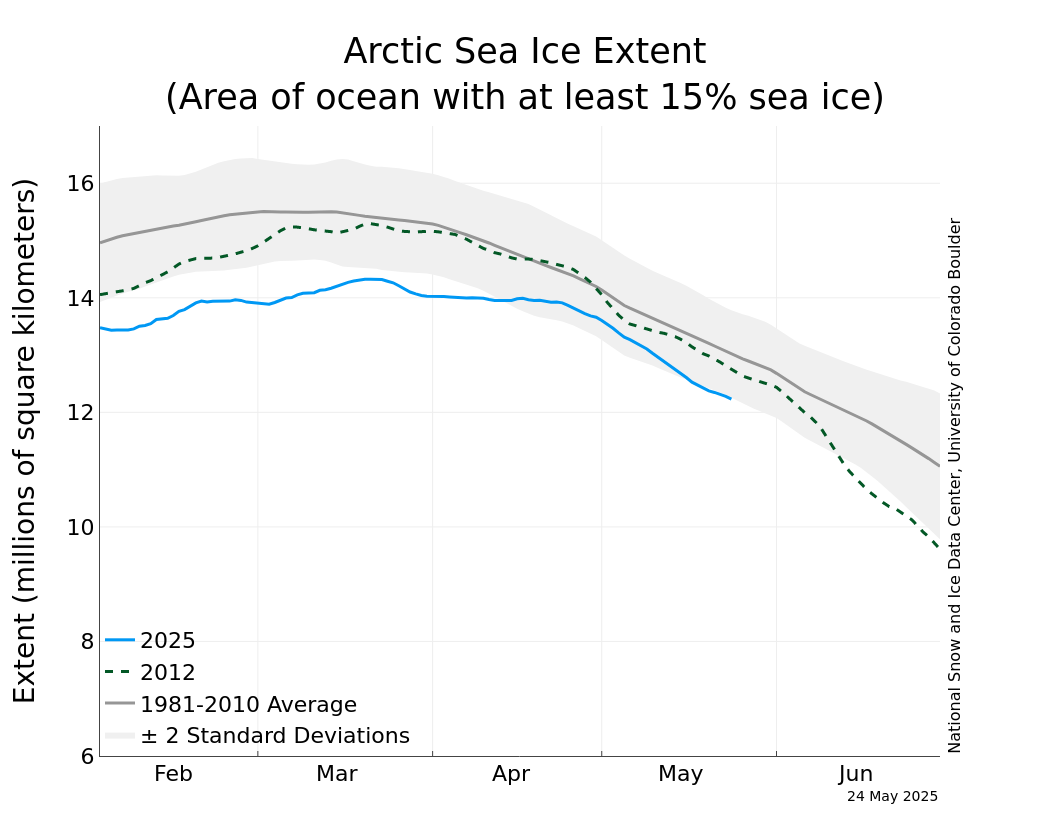
Data: According to NASA, global temperature has increased by about 1 degree Fahrenheit since 1970.Claim 1970: “In ten years all important animal life in the sea will be extinct. Large areas of coastline will have to be evacuated because of the stench of dead fish.” Paul Ehrlich, speech during Earth Day, 1970.Claim 1972: “Artic specialist Bernt Balchen says a general warming trend over the North Pole is melting the polar ice cap and may produce an ice-free Arctic Ocean by the year 2000.” Christian Science Monitor, June 8, 1972.
Data: Ice coverage has fallen, though as of last month, the Arctic Ocean had 3.82 million square miles of ice cover — an area larger than the continental United States — according to The National Snow and Ice Data Center.Claims 1974: “… when metereologists take an average of temperatures around the globe they find the atmosphere has been growing gradually cooler for the past three decades. The trend shows no indication of reversing. Climatological Cassandras are becoming increasingly apprehensive, for the weather aberrations they are studying may be the harbinger of another ice age. Telltale signs are everywhere–from the unexpected persistence and thickness of pack ice int eh waters around Iceland to the southward migration of a warmth-loving creature like the armadillo from the Midwest. When Climatologist George J. Kukla of Columbia University’s Lamont-Doherty Geological Observatory and his wife Helena analyzed satellite weather data fro the Northern Hemisphere, they found that the area of ice and snow cover had suddenly increased by 12% in 1971 and the increase has persisted ever since. Areas of Baffin Island in the Canadia Arctic, for example, were once totally free of any snow in summer; now they are covered year round.”
Later in the article, “Whatever the cause of the cooling trend, its effects could be extremely serious, if not catastrophic. Scientists figure that only a 1% decrease in the amount of sunlight hitting the earth’s surface could tip teh climatic balance, and cool the planet enough to send it sliding down the road to another ice age within only a few hundred years.”
Source: “Another Ice Age,” Time Magazine, June 24, 1974.Claim 1989: “Using computer models, researchers concluded that global warming would raise average annual temperatures nationwide two degrees by 2010.” Associated Press,May 15, 1989.
Data: According to NASA, global temperature has increased by about 0.7 degrees Fahrenheit since 1989. And U.S. temperature has increased even less over the same period.Claims: “Britain’s winter ends tomorrow with further indications of a striking environmental change: snow is starting to disappear from our lives.”
“Sledges, snowmen, snowballs and … are all a rapidly diminishing part of Britain’s culture, as warmer winters–which scientists are attributing to global climate change–produce not only fewer white Christmases, but fewer white Januaries and Februaries.”
“London’s last substantial snowfall was in February 1991.” “Global warming, the heating of the atmosphere by increased amounts of industrial gases, is now accepted as a reality by the international community.”
According to Dr. David Viner, a senior research scientist at the climatic research unit (CRU) of the University of East Anglia, within a few years “children just aren’t going to know what snow is” and winter snowfall will be “a very rare and exciting event.” Interviewed by the UK Independent, March 20, 2000.
“David Parker, at the Hadley Centre for Climate Prediction and Research in Berkshire, says ultimately, British children could have only virtual experience of snow.”
See “Snowfalls are now just a thing of the past.” The Independent. March 20, 2000.
Data: “Coldest December Since records began as temperatures plummet to minus 10 C bringing travel chaos across Britain.” Mailonline. Dec. 18, 2010.Claim: “[By] 1995, the greenhouse effect would be desolating the heartlands of North America and Eurasia with horrific drought, causing crop failures and food riots … [By 1996] The Platte River of Nebraska would be dry, while a continent-wide black blizzard of prairie topsoil will stop traffic on interstates, strip paint from houses and shut down computers.” Michel Oppenheimer and Robert H. Boyle, Dead Heat, St. Martin’s Press, 1990. Oppenheimer is the Albert G. Milbank Professor of Geosciences and International Affairs in the Woodrow Wilson School and the Department of Geosciences at Princeton University. He is the Director of the Program in Science, Technology, and Environmental Policy at the Wilson School. He was formerly a senior scientist with the Environmental Defense Fund, the largest non-governmental organization in the U.S. that examines problems and solutions to greenhouse gases.Data: When asked about these old predictions Oppenheimer stated, “On the whole I would stand by these predictions — not predictions, sorry, scenarios — as having at least in a general way actually come true,” he said. “There’s been extensive drought, devastating drought, in significant parts of the world. The fraction of the world that’s in drought has increased over that period.”However, that claim is not obviously true. Data from NASA’s Goddard Space Flight Center show that precipitation — rain and snow — has increased slightly over the century.–How could scientists have made such off-base claims? Dr. Paul Ehrlich, author of “The Population Bomb” and president of Stanford University’s Center for Conservation Biology, told FoxNews.com that ideas about climate science changed a great deal in the the ’70s and ’80s.Ehrlich told FoxNews.com that the consequences of future warming could be dire.=============================================================Source: University of Georgia, Terry College of Business. Economics 2200, Economic Development of the US, David B. Mustard
Showing posts with label Climate. Show all posts
Showing posts with label Climate. Show all posts
Saturday, January 19, 2013
Great moments in bad predictions
From Anthony Watts, comes this collection of bad predictions:

Monday, December 20, 2010
The End of Snow Again
From Britain's Independent in March 2000:
Fast forward to 2010.
Britain's winter ends tomorrow with further indications of a striking environmental change: snow is starting to disappear from our lives.
Sledges, snowmen, snowballs and the excitement of waking to find that the stuff has settled outside are all a rapidly diminishing part of Britain's culture, as warmer winters - which scientists are attributing to global climate change - produce not only fewer white Christmases, but fewer white Januaries and Februaries.
The first two months of 2000 were virtually free of significant snowfall in much of lowland Britain, and December brought only moderate snowfall in the South-east. It is the continuation of a trend that has been increasingly visible in the past 15 years: in the south of England, for instance, from 1970 to 1995 snow and sleet fell for an average of 3.7 days, while from 1988 to 1995 the average was 0.7 days. London's last substantial snowfall was in February 1991.
Global warming, the heating of the atmosphere by increased amounts of industrial gases, is now accepted as a reality by the international community. Average temperatures in Britain were nearly 0.6°C higher in the Nineties than in 1960-90, and it is estimated that they will increase by 0.2C every decade over the coming century. Eight of the 10 hottest years on record occurred in the Nineties.
However, the warming is so far manifesting itself more in winters which are less cold than in much hotter summers. According to Dr David Viner, a senior research scientist at the climatic research unit (CRU) of the University of East Anglia,within a few years winter snowfall will become "a very rare and exciting event".
"Children just aren't going to know what snow is," he said.
Fast forward to 2010.
Christmas travellers are facing severe disruption as heavy snow falls across many parts of the UK.
Airport closures have hit thousands of passengers. Heathrow expects some flights to depart from 0600 GMT, while many Gatwick flights remain cancelled.
Roads, railways and airports are affected across the UK, amid severe weather warnings for many areas.
Airports in Germany, France, Italy and the Netherlands are also suffering cancellations and delays.
The snow is forecast to continue in many parts of the UK, with up to 25cm expected in some areas of England, and a number of severe weather warnings are in place.
Saturday, July 12, 2008
The Cooling World
Newsweek: April, 28th, 1975:
There are ominous signs that the Earth’s weather patterns have begun to change dramatically and that these changes may portend a drastic decline in food production – with serious political implications for just about every nation on Earth. The drop in food output could begin quite soon, perhaps only 10 years from now. The regions destined to feel its impact are the great wheat-producing lands of Canada and the U.S.S.R. in the North, along with a number of marginally self-sufficient tropical areas – parts of India, Pakistan, Bangladesh, Indochina and Indonesia – where the growing season is dependent upon the rains brought by the monsoon.
The evidence in support of these predictions has now begun to accumulate so massively that meteorologists are hard-pressed to keep up with it. In England, farmers have seen their growing season decline by about two weeks since 1950, with a resultant overall loss in grain production estimated at up to 100,000 tons annually. During the same time, the average temperature around the equator has risen by a fraction of a degree – a fraction that in some areas can mean drought and desolation. Last April, in the most devastating outbreak of tornadoes ever recorded, 148 twisters killed more than 300 people and caused half a billion dollars’ worth of damage in 13 U.S. states.
To scientists, these seemingly disparate incidents represent the advance signs of fundamental changes in the world’s weather. The central fact is that after three quarters of a century of extraordinarily mild conditions, the earth’s climate seems to be cooling down. Meteorologists disagree about the cause and extent of the cooling trend, as well as over its specific impact on local weather conditions. But they are almost unanimous in the view that the trend will reduce agricultural productivity for the rest of the century. If the climatic change is as profound as some of the pessimists fear, the resulting famines could be catastrophic. “A major climatic change would force economic and social adjustments on a worldwide scale,” warns a recent report by the National Academy of Sciences, “because the global patterns of food production and population that have evolved are implicitly dependent on the climate of the present century.”
A survey completed last year by Dr. Murray Mitchell of the National Oceanic and Atmospheric Administration reveals a drop of half a degree in average ground temperatures in the Northern Hemisphere between 1945 and 1968. According to George Kukla of Columbia University, satellite photos indicated a sudden, large increase in Northern Hemisphere snow cover in the winter of 1971-72. And a study released last month by two NOAA scientists notes that the amount of sunshine reaching the ground in the continental U.S. diminished by 1.3% between 1964 and 1972.
To the layman, the relatively small changes in temperature and sunshine can be highly misleading. Reid Bryson of the University of Wisconsin points out that the Earth’s average temperature during the great Ice Ages was only about seven degrees lower than during its warmest eras – and that the present decline has taken the planet about a sixth of the way toward the Ice Age average. Others regard the cooling as a reversion to the “little ice age” conditions that brought bitter winters to much of Europe and northern America between 1600 and 1900 – years when the Thames used to freeze so solidly that Londoners roasted oxen on the ice and when iceboats sailed the Hudson River almost as far south as New York City.
Just what causes the onset of major and minor ice ages remains a mystery. “Our knowledge of the mechanisms of climatic change is at least as fragmentary as our data,” concedes the National Academy of Sciences report. “Not only are the basic scientific questions largely unanswered, but in many cases we do not yet know enough to pose the key questions.”
Meteorologists think that they can forecast the short-term results of the return to the norm of the last century. They begin by noting the slight drop in overall temperature that produces large numbers of pressure centers in the upper atmosphere. These break up the smooth flow of westerly winds over temperate areas. The stagnant air produced in this way causes an increase in extremes of local weather such as droughts, floods, extended dry spells, long freezes, delayed monsoons and even local temperature increases – all of which have a direct impact on food supplies.
“The world’s food-producing system,” warns Dr. James D. McQuigg of NOAA’s Center for Climatic and Environmental Assessment, “is much more sensitive to the weather variable than it was even five years ago.” Furthermore, the growth of world population and creation of new national boundaries make it impossible for starving peoples to migrate from their devastated fields, as they did during past famines.
Climatologists are pessimistic that political leaders will take any positive action to compensate for the climatic change, or even to allay its effects. They concede that some of the more spectacular solutions proposed, such as melting the Arctic ice cap by covering it with black soot or diverting arctic rivers, might create problems far greater than those they solve. But the scientists see few signs that government leaders anywhere are even prepared to take the simple measures of stockpiling food or of introducing the variables of climatic uncertainty into economic projections of future food supplies. The longer the planners delay, the more difficult will they find it to cope with climatic change once the results become grim reality.—PETER GWYNNE with bureau reports
Global Cooling
Time Magazine: June 24th, 1974:
In Africa, drought continues for the sixth consecutive year, adding terribly to the toll of famine victims. During 1972 record rains in parts of the U.S., Pakistan and Japan caused some of the worst flooding in centuries. In Canada's wheat belt, a particularly chilly and rainy spring has delayed planting and may well bring a disappointingly small harvest. Rainy Britain, on the other hand, has suffered from uncharacteristic dry spells the past few springs. A series of unusually cold winters has gripped the American Far West, while New England and northern Europe have recently experienced the mildest winters within anyone's recollection.
As they review the bizarre and unpredictable weather pattern of the past several years, a growing number of scientists are beginning to suspect that many seemingly contradictory meteorological fluctuations are actually part of a global climatic upheaval. However widely the weather varies from place to place and time to time, when meteorologists take an average of temperatures around the globe they find that the atmosphere has been growing gradually cooler for the past three decades. The trend shows no indication of reversing. Climatological Cassandras are becoming increasingly apprehensive, for the weather aberrations they are studying may be the harbinger of another ice age.
Telltale signs are everywhere —from the unexpected persistence and thickness of pack ice in the waters around Iceland to the southward migration of a warmth-loving creature like the armadillo from the Midwest.Since the 1940s the mean global temperature has dropped about 2.7° F. Although that figure is at best an estimate, it is supported by other convincing data. When Climatologist George J. Kukla of Columbia University's Lamont-Doherty Geological Observatory and his wife Helena analyzed satellite weather data for the Northern Hemisphere, they found that the area of the ice and snow cover had suddenly increased by 12% in 1971 and the increase has persisted ever since. Areas of Baffin Island in the Canadian Arctic, for example, were once totally free of any snow in summer; now they are covered year round.
Scientists have found other indications of global cooling. For one thing there has been a noticeable expansion of the great belt of dry, high-altitude polar winds —the so-called circumpolar vortex—that sweep from west to east around the top and bottom of the world. Indeed it is the widening of this cap of cold air that is the immediate cause of Africa's drought. By blocking moisture-bearing equatorial winds and preventing them from bringing rainfall to the parched sub-Sahara region, as well as other drought-ridden areas stretching all the way from Central America to the Middle East and India, the polar winds have in effect caused the Sahara and other deserts to reach farther to the south. Paradoxically, the same vortex has created quite different weather quirks in the U.S. and other temperate zones. As the winds swirl around the globe, their southerly portions undulate like the bottom of a skirt. Cold air is pulled down across the Western U.S. and warm air is swept up to the Northeast. The collision of air masses of widely differing temperatures and humidity can create violent storms—the Midwest's recent rash of disastrous tornadoes, for example.
Sunspot Cycle. The changing weather is apparently connected with differences in the amount of energy that the earth's surface receives from the sun. Changes in the earth's tilt and distance from the sun could, for instance, significantly increase or decrease the amount of solar radiation falling on either hemisphere—thereby altering the earth's climate. Some observers have tried to connect the eleven-year sunspot cycle with climate patterns, but have so far been unable to provide a satisfactory explanation of how the cycle might be involved.
Man, too, may be somewhat responsible for the cooling trend. The University of Wisconsin's Reid A. Bryson and other climatologists suggest that dust and other particles released into the atmosphere as a result of farming and fuel burning may be blocking more and more sunlight from reaching and heating the surface of the earth.
Climatic Balance. Some scientists like Donald Oilman, chief of the National Weather Service's long-range-prediction group, think that the cooling trend may be only temporary. But all agree that vastly more information is needed about the major influences on the earth's climate. Indeed, it is to gain such knowledge that 38 ships and 13 aircraft, carrying scientists from almost 70 nations, are now assembling in the Atlantic and elsewhere for a massive 100-day study of the effects of the tropical seas and atmosphere on worldwide weather. The study itself is only part of an international scientific effort known acronymically as GARP (for Global Atmospheric Research Program).
Whatever the cause of the cooling trend, its effects could be extremely serious, if not catastrophic. Scientists figure that only a 1% decrease in the amount of sunlight hitting the earth's surface could tip the climatic balance, and cool the planet enough to send it sliding down the road to another ice age within only a few hundred years.
The earth's current climate is something of an anomaly; in the past 700,000 years, there have been at least seven major episodes of glaciers spreading over much of the planet. Temperatures have been as high as they are now only about 5% of the time. But there is a peril more immediate than the prospect of another ice age. Even if temperature and rainfall patterns change only slightly in the near future in one or more of the three major grain-exporting countries—the U.S., Canada and Australia —global food stores would be sharply reduced. University of Toronto Climatologist Kenneth Hare, a former president of the Royal Meteorological Society, believes that the continuing drought and the recent failure of the Russian harvest gave the world a grim premonition of what might happen. Warns Hare: "I don't believe that the world's present population is sustainable if there are more than three years like 1972 in a row."

Friday, July 11, 2008
Climate Change
I am a big global warming skeptic, but it's a bit early to add the current global warming hysteria to a collection of bad predictions. But I can include some predictions from past climate change fads.
The Business Media Institute has a great report surveying the previous bouts of global warming and global cooling hysteria. There seems to be a periodicity of about 20-30 years between switching from dire predictions of the coming ice age versus dire predictions of the coming heat wave.
Follow the link for the entire piece, but here are a few select gems from the report:
The Business Media Institute has a great report surveying the previous bouts of global warming and global cooling hysteria. There seems to be a periodicity of about 20-30 years between switching from dire predictions of the coming ice age versus dire predictions of the coming heat wave.
Follow the link for the entire piece, but here are a few select gems from the report:
It was five years before the turn of the century and major media were warning of disastrous climate change. Page six of The New York Times was headlined with the serious concerns of “geologists.” Only the president at the time wasn’t Bill Clinton; it was Grover Cleveland. And the Times wasn’t warning about global warming – it was telling readers the looming dangers of a new ice age.
The year was 1895, and it was just one of four different time periods in the last 100 years when major print media predicted an impending climate crisis. Each prediction carried its own elements of doom, saying Canada could be “wiped out” or lower crop yields would mean “billions will die.”
Just as the weather has changed over time, so has the reporting – blowing hot or cold with short-term changes in temperature.
Following the ice age threats from the late 1800s, fears of an imminent and icy catastrophe were compounded in the 1920s by Arctic explorer Donald MacMillan and in obsession with the news of his polar expedition. As the Times put it on Feb. 24, 1895, “Geologists Think the World May Be Frozen Up Again.”
Those concerns lasted well into the late 1920s. But when the earth’s surface warmed less than half a degree, newspapers and magazines responded with stories about the new threat. Once again the Times was out in front, cautioning “the earth is steadily growing warmer.”
After a while, that second phase of climate cautions began to fade. By 1954, Fortune magazine was warming to another cooling trend and ran an article titled “Climate – the Heat May Be Off.” As the United States and the old Soviet Union faced off, the media joined them with reports of a more dangerous Cold War of Man vs. Nature.
The New York Times ran warming stories into the late 1950s, but it too came around to the new fears. Just three decades ago, in 1975, the paper reported: “A Major Cooling Widely Considered to Be Inevitable.”
That trend, too, cooled off and was replaced by the current era of reporting on the dangers of global warming. Just six years later, on Aug. 22, 1981, the Times quoted seven government atmospheric scientists who predicted global warming of an “almost unprecedented magnitude.”In all, the print news media have warned of separate climate changes in slightly more than 100 years – global cooling, warming, cooling again, and, perhaps not so finally, warming. Some current warming stories combine the concepts and claim the next ice age will be triggered by rising temperatures – the theme of the 2004 movie “The Day After Tomorrow.”
Subscribe to:
Posts (Atom)


 Posts
Posts