While searching for something else, I came across this entertaining collection of grand predictive failures related to resources and climate change, along with some of the biggest predictive failures of Paul Ehrlich. I thought it worth sharing.Exhaustion of Resources“Indeed it is certain, it is clear to see, that the earth itself is currently more cultivated and developed than in earlier times. Now all places are accessible, all are documented, all are full of business. The most charming farms obliterate empty places, ploughed fields vanquish forests, herds drive out wild beasts, sandy places are planted with crops, stones are fixed, swamps drained, and there are such great cities where formerly hardly a hut… everywhere there is a dwelling, everywhere a multitude, everywhere a government, everywhere there is life. The greatest evidence of the large number of people: we are burdensome to the world, the resources are scarcely adequate to us; and our needs straiten us and complaints are everywhere while already nature does not sustain us.”
- In 1865, Stanley Jevons (one of the most recognized 19th century economists) predicted that England would run out of coal by 1900, and that England’s factories would grind to a standstill.
- In 1885, the US Geological Survey announced that there was “little or no chance” of oil being discovered in California.
- In 1891, it said the same thing about Kansas and Texas. (See Osterfeld, David.Prosperity Versus Planning : How Government Stifles Economic Growth. New York : Oxford University Press, 1992.)
- In 1939 the US Department of the Interior said that American oil supplies would last only another 13 years.
- 1944 federal government review predicted that by now the US would have exhausted its reserves of 21 of 41 commodities it examined. Among them were tin, nickel, zinc, lead and manganese.
- In 1949 the Secretary of the Interior announced that the end of US oil was in sight.
Claim: In 1952 the US President’s Materials Policy Commission concluded that by the mid-1970s copper production in the US could not exceed 800,000 tons and that lead production would be at most 300,000 tons per year.
Data: But copper production in 1973 was 1.6 million tons, and by 1974 lead production had reached 614,000 tons – 100% higher than predicted.Claims: In 1968, Paul R. Ehrlich wrote The Population Bomb and declared that the battle to feed humanity had been lost and that there would be a major food shortage in the US. “In the 1970s … hundreds of millions are going to starve to death,” and by the 1980s most of the world’s important resources would be depleted. He forecast that 65 million Americans would die of starvation between 1980-1989 and that by 1999, the US population would decline to 22.6 million. The problems in the US would be relatively minor compared to those in the rest of the world. (Ehrlich, Paul R. The Population Bomb. New York, Ballantine Books, 1968.) New Scientist magazine underscored his speech in an editorial titled “In Praise of Prophets.”Claim: “By the year 2000 the United Kingdom will be simply a small group of impoverished islands, inhabited by some 70 million hungry people … If I were a gambler, I would take even money that England will not exist in the year 2000.” Paul Ehrlich, Speech at British Institute For Biology, September 1971.Claim: Ehrlich wrote in 1968, “I have yet to meet anyone familiar with the situation who thinks India will be self-sufficient in food by 1971, if ever.”
Data: Yet in a only few years India was exporting food and significantly changed its food production capacity. Ehrlich must have noted this because in the 1971 version of his book this comment is deleted (Julian Simon, The Ultimate Resource, Princeton: Princeton Univesity Press, 1981, p. 64).The Limits to Growth (1972) – projected the world would run out of gold by 1981, mercury and silver by 1985, tin by 1987, zinc by 1990, petroleum by 1992, and copper, lead and natural gas by 1993. It also stated that the world had only 33-49 years of aluminum resources left, which means we should run out sometime between 2005-2021. (See Donella Meadows et al., The Limits to Growth: A Report for the Club of Rome’s Project on the Predicament of Mankind. New York: New American Library, 1972.Claim: In 1974, the US Geological Survey announced “at 1974 technology and 1974 price” the US had only a 10-year supply of natural gas.Data: The American Gas Association said that gas supplies were sufficient for the next 1,000-2,500 years. (Julian Simon, Population Matters. New Jersey: Transaction Publications, 1990): p. 90.Population and PovertyIn the mid 1970s the US government sponsored a travelling exhibit for schoolchildren titled, “Population: The Problem is Us.” (Jacqueline Kasun, The War Against Population, San Francisco: CA, Ignatius, 1988, p. 21.)In 1973, Supreme Court Justice Potter Stewart’s vote in Roe v. Wade was influenced by this idea, according to Bob Woodward and Scott Armstrong: “As Stewart saw it, abortion was becoming one reasonable solution to population control” (quoted in Newsweek of September 14, 1987, p. 33.).In 1989, when the US Supreme Court was hearing the Webster case, Justice Sandra Day O’Connor brought the idea of overpopulation into a hypothetical question she asked of Charles Fried, former solicitor-general, “Do you think that the state has the right to, if in a future century we had a serious overpopulation problem, has a right to require women to have abortions after so many children?”World Bank president Barber Conable calls for population control because “poverty and rapid population growth reinforce each other” (Washington Post, July 16, 1990, p. A13)
Prince Philip advises us that “It must be obvious by now that further population growth in any country is undesirable” (Washington Post, May 8, 1990, p. A26)
37 Senators wrote President Bush in support of funding for population control (Washington Post, April 1, 1990, p. H1)
The Trilateral Commission and the American Assembly call for reduction in population growth (U. S. News and World Report, May 7, 1990)
Newsweek‘s year-ending cover story concluded that “Foremost of the new realities is the world’s population problem” (December 25, 1990, p.44)
The president of NOW warns that continued population growth would be a “catastrophe” (Nat Hentoff in the Washington Post, July 29, 1989, p. A17)Ted Turner (Atlanta Journal Constitution, Wed. Dec. 2, 1998) in an address to the Society of Environmental Journalists in Chattanooga – blamed Christianity for overpopulation and environmental degradation, and argued that the people who disagree with him are “dummies.” He stated in part, “The Judeo-Christian religion says man was given dominion over everything, and his salvation was that he was to go out and increase and multiply. Well, we have done that … to the point where in Calcutta, it’s a hellhole. So it’s not an environmentally friendly religion.”Ellen Goodman laments “People Pollution” (Washington Post, March 3, 1990, p. A25)
Herblock cartoon shows that the U. S. neglecting the “world population explosion” (Washington Post, July 19, 1990, p. A22)
Hobart Rowen likens population growth to “the pond weed [which] grows in huge leaps” (Washington Post, April 1, 1990, p. H8).
A Newsweek “My Turn” suggests giving every teen-age girl a check for up to $1200 each year that she does not have a baby “in order to stop the relentless increase of humanity” (Noel Perrin. “A Nonbearing Account”, April 2, 1990, p. 9).Climate ChangeClaim Jan. 1970: “By 1985, air pollution will have reduced the amount of sunlight reaching earth by one half.” Life Magazine, January 1970. Life Magazine also noted that some people disagree, “but scientists have solid experimental and historical evidence to support each of the predictions.”
Data: Air quality has actually improved since 1970. Studies find that sunlight reaching the Earth fell by somewhere between 3 and 5 percent over the period in question.Claim April 1970: “If present trends continue, the world will be … eleven degrees colder by the year 2000. This is about twice what it would take to put us in an ice age.” Kenneth E.F. Watt, in Earth Day, 1970.
Data: According to NASA, global temperature has increased by about 1 degree Fahrenheit since 1970.Claim 1970: “In ten years all important animal life in the sea will be extinct. Large areas of coastline will have to be evacuated because of the stench of dead fish.” Paul Ehrlich, speech during Earth Day, 1970.Claim 1972: “Artic specialist Bernt Balchen says a general warming trend over the North Pole is melting the polar ice cap and may produce an ice-free Arctic Ocean by the year 2000.” Christian Science Monitor, June 8, 1972.
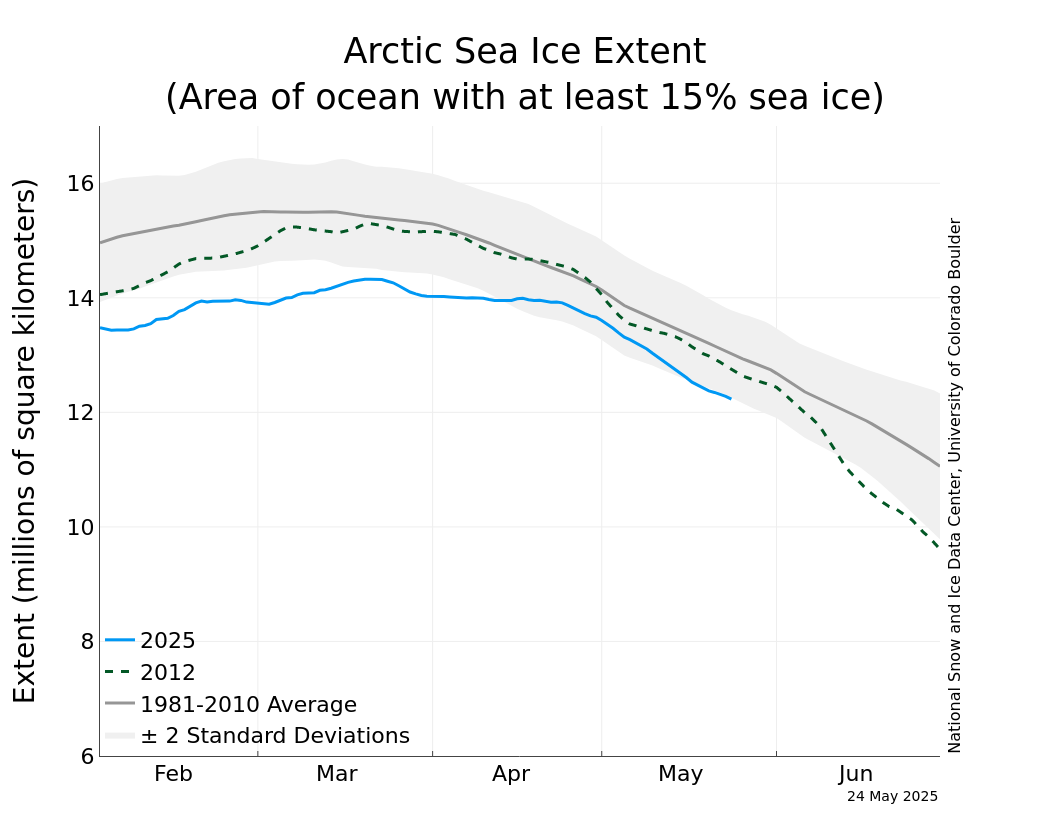
Data: Ice coverage has fallen, though as of last month, the Arctic Ocean had 3.82 million square miles of ice cover — an area larger than the continental United States — according to The National Snow and Ice Data Center.Claims 1974: “… when metereologists take an average of temperatures around the globe they find the atmosphere has been growing gradually cooler for the past three decades. The trend shows no indication of reversing. Climatological Cassandras are becoming increasingly apprehensive, for the weather aberrations they are studying may be the harbinger of another ice age. Telltale signs are everywhere–from the unexpected persistence and thickness of pack ice int eh waters around Iceland to the southward migration of a warmth-loving creature like the armadillo from the Midwest. When Climatologist George J. Kukla of Columbia University’s Lamont-Doherty Geological Observatory and his wife Helena analyzed satellite weather data fro the Northern Hemisphere, they found that the area of ice and snow cover had suddenly increased by 12% in 1971 and the increase has persisted ever since. Areas of Baffin Island in the Canadia Arctic, for example, were once totally free of any snow in summer; now they are covered year round.”
Later in the article, “Whatever the cause of the cooling trend, its effects could be extremely serious, if not catastrophic. Scientists figure that only a 1% decrease in the amount of sunlight hitting the earth’s surface could tip teh climatic balance, and cool the planet enough to send it sliding down the road to another ice age within only a few hundred years.”
Source: “Another Ice Age,” Time Magazine, June 24, 1974.Claim 1989: “Using computer models, researchers concluded that global warming would raise average annual temperatures nationwide two degrees by 2010.” Associated Press,May 15, 1989.
Data: According to NASA, global temperature has increased by about 0.7 degrees Fahrenheit since 1989. And U.S. temperature has increased even less over the same period.Claims: “Britain’s winter ends tomorrow with further indications of a striking environmental change: snow is starting to disappear from our lives.”
“Sledges, snowmen, snowballs and … are all a rapidly diminishing part of Britain’s culture, as warmer winters–which scientists are attributing to global climate change–produce not only fewer white Christmases, but fewer white Januaries and Februaries.”
“London’s last substantial snowfall was in February 1991.” “Global warming, the heating of the atmosphere by increased amounts of industrial gases, is now accepted as a reality by the international community.”
According to Dr. David Viner, a senior research scientist at the climatic research unit (CRU) of the University of East Anglia, within a few years “children just aren’t going to know what snow is” and winter snowfall will be “a very rare and exciting event.” Interviewed by the UK Independent, March 20, 2000.
“David Parker, at the Hadley Centre for Climate Prediction and Research in Berkshire, says ultimately, British children could have only virtual experience of snow.”
See “Snowfalls are now just a thing of the past.” The Independent. March 20, 2000.
Data: “Coldest December Since records began as temperatures plummet to minus 10 C bringing travel chaos across Britain.” Mailonline. Dec. 18, 2010.Claim: “[By] 1995, the greenhouse effect would be desolating the heartlands of North America and Eurasia with horrific drought, causing crop failures and food riots … [By 1996] The Platte River of Nebraska would be dry, while a continent-wide black blizzard of prairie topsoil will stop traffic on interstates, strip paint from houses and shut down computers.” Michel Oppenheimer and Robert H. Boyle, Dead Heat, St. Martin’s Press, 1990. Oppenheimer is the Albert G. Milbank Professor of Geosciences and International Affairs in the Woodrow Wilson School and the Department of Geosciences at Princeton University. He is the Director of the Program in Science, Technology, and Environmental Policy at the Wilson School. He was formerly a senior scientist with the Environmental Defense Fund, the largest non-governmental organization in the U.S. that examines problems and solutions to greenhouse gases.Data: When asked about these old predictions Oppenheimer stated, “On the whole I would stand by these predictions — not predictions, sorry, scenarios — as having at least in a general way actually come true,” he said. “There’s been extensive drought, devastating drought, in significant parts of the world. The fraction of the world that’s in drought has increased over that period.”However, that claim is not obviously true. Data from NASA’s Goddard Space Flight Center show that precipitation — rain and snow — has increased slightly over the century.–How could scientists have made such off-base claims? Dr. Paul Ehrlich, author of “The Population Bomb” and president of Stanford University’s Center for Conservation Biology, told FoxNews.com that ideas about climate science changed a great deal in the the ’70s and ’80s.Ehrlich told FoxNews.com that the consequences of future warming could be dire.=============================================================Source: University of Georgia, Terry College of Business. Economics 2200, Economic Development of the US, David B. Mustard
Showing posts with label Technology. Show all posts
Showing posts with label Technology. Show all posts
Saturday, January 19, 2013
Great moments in bad predictions
From Anthony Watts, comes this collection of bad predictions:

Thursday, July 24, 2008
The Year 2000 as seen in 1900
Here's a collection of predictions made in The Ladies Home Journal of December 1900 about life in the year 2000. Quite a few are not so bad, but I include the entire list for completeness with a few editorial comments:
Prediction #1: There will probably be from 350,000,000 to 500,000,000 people in America and its possessions by the lapse of another century. [not bad] Nicaragua will ask for admission to our Union after the completion of the great canal. Mexico will be next. Europe, seeking more territory to the south of us, will cause many of the South and Central American republics to be voted into the Union by their own people.” [er, no]
Prediction #2: The American will be taller by from one to two inches. His increase of stature will result from better health, due to vast reforms in medicine, sanitation, food and athletics. He will live fifty years instead of thirty-five as at present – for he will reside in the suburbs. [pretty good, actually didn't go far enough] The city house will practically be no more. Building in blocks will be illegal. The trip from suburban home to office will require a few minutes only. A penny will pay the fare. [er, no]
Prediction #3: Gymnastics will begin in the nursery, where toys and games will be designed to strengthen the muscles. Exercise will be compulsory in the schools. Every school, college and community will have a complete gymnasium. All cities will have public gymnasiums. A man or woman unable to walk ten miles at a stretch will be regarded as a weakling. [not quite]
Prediction #4: There Will Be No Street Cars in Our Large Cities. All hurry traffic will be below or high above ground when brought within city limits. In most cities it will be confined to broad subways or tunnels, well lighted and well ventilated, or to high trestles with “moving-sidewalk” stairways leading to the top. These underground or overhead streets will teem with capacious automobile passenger coaches and freight with cushioned wheels. Subways or trestles will be reserved for express trains. Cities, therefore, will be free from all noises. [F]
Prediction #5: Trains will run two miles a minute, normally; express trains one hundred and fifty miles an hour. To go from New York to San Francisco will take a day and a night by fast express. There will be cigar-shaped electric locomotives hauling long trains of cars. Cars will, like houses, be artificially cooled. Along the railroads there will be no smoke, no cinders, because coal will neither be carried nor burned. There will be no stops for water. Passengers will travel through hot or dusty country regions with windows down. [C]
Prediction #6: Automobiles will be cheaper than horses are today. Farmers will own automobile hay-wagons, automobile truck-wagons, plows, harrows and hay-rakes. A one-pound motor in one of these vehicles will do the work of a pair of horses or more. Children will ride in automobile sleighs in winter. Automobiles will have been substituted for every horse vehicle now known. There will be, as already exist today, automobile hearses, automobile police patrols, automobile ambulances, automobile street sweepers. The horse in harness will be as scarce, if, indeed, not even scarcer, then as the yoked ox is today. [B+]
Prediction #7: There will be air-ships, but they will not successfully compete with surface cars and water vessels for passenger or freight traffic. They will be maintained as deadly war-vessels by all military nations. Some will transport men and goods. Others will be used by scientists making observations at great heights above the earth. [B]
Prediction #8: Aerial War-Ships and Forts on Wheels. Giant guns will shoot twenty-five miles or more, and will hurl anywhere within such a radius shells exploding and destroying whole cities. Such guns will be armed by aid of compasses when used on land or sea, and telescopes when directed from great heights. Fleets of air-ships, hiding themselves with dense, smoky mists, thrown off by themselves as they move, will float over cities, fortifications, camps or fleets. They will surprise foes below by hurling upon them deadly thunderbolts. These aerial war-ships will necessitate bomb-proof forts, protected by great steel plates over their tops as well as at their sides. Huge forts on wheels will dash across open spaces at the speed of express trains of to-day. They will make what are now known as cavalry charges. Great automobile plows will dig deep entrenchments as fast as soldiers can occupy them. Rifles will use silent cartridges. Submarine boats submerged for days will be capable of wiping a whole navy off the face of the deep. Balloons and flying machines will carry telescopes of one-hundred-mile vision with camera attachments, photographing an enemy within that radius. These photographs as distinct and large as if taken from across the street, will be lowered to the commanding officer in charge of troops below. [B+]
Prediction #9: Photographs will be telegraphed from any distance. If there be a battle in China a hundred years hence snapshots of its most striking events will be published in the newspapers an hour later. Even to-day photographs are being telegraphed over short distances. Photographs will reproduce all of Nature’s colors. [A]
Prediction #10: Man will See Around the World. Persons and things of all kinds will be brought within focus of cameras connected electrically with screens at opposite ends of circuits, thousands of miles at a span. American audiences in their theatres will view upon huge curtains before them the coronations of kings in Europe or the progress of battles in the Orient. The instrument bringing these distant scenes to the very doors of people will be connected with a giant telephone apparatus transmitting each incidental sound in its appropriate place. Thus the guns of a distant battle will be heard to boom when seen to blaze, and thus the lips of a remote actor or singer will be heard to utter words or music when seen to move. [A]
Prediction #11: No Mosquitoes nor Flies. Insect screens will be unnecessary. Mosquitoes, house-flies and roaches will have been practically exterminated. Boards of health will have destroyed all mosquito haunts and breeding-grounds, drained all stagnant pools, filled in all swamp-lands, and chemically treated all still-water streams. The extermination of the horse and its stable will reduce the house-fly. [F]
Prediction #12: Peas as Large as Beets. Peas and beans will be as large as beets are to-day. Sugar cane will produce twice as much sugar as the sugar beet now does. Cane will once more be the chief source of our sugar supply. The milkweed will have been developed into a rubber plant. Cheap native rubber will be harvested by machinery all over this country. Plants will be made proof against disease microbes just as readily as man is to-day against smallpox. The soil will be kept enriched by plants which take their nutrition from the air and give fertility to the earth. [B, maybe A after a few more years of genetic research]
Prediction #13: Strawberries as Large as Apples will be eaten by our great-great-grandchildren for their Christmas dinners a hundred years hence. Raspberries and blackberries will be as large. One will suffice for the fruit course of each person. Strawberries and cranberries will be grown upon tall bushes. Cranberries, gooseberries and currants will be as large as oranges. One cantaloupe will supply an entire family. Melons, cherries, grapes, plums, apples, pears, peaches and all berries will be seedless. Figs will be cultivated over the entire United States. [C]
Prediction #14: Black, Blue and Green Roses. Roses will be as large as cabbage heads. Violets will grow to the size of orchids. A pansy will be as large in diameter as a sunflower. A century ago the pansy measured but half an inch across its face. There will be black, blue and green roses. It will be possible to grow any flower in any color and to transfer the perfume of a scented flower to another which is odorless. Then may the pansy be given the perfume of the violet. [C]
Prediction #15: No Foods will be Exposed. Storekeepers who expose food to air breathed out by patrons or to the atmosphere of the busy streets will be arrested with those who sell stale or adulterated produce. Liquid-air refrigerators will keep great quantities of food fresh for long intervals. [C]
Prediction #16: There will be No C, X or Q in our every-day alphabet. They will be abandoned because unnecessary. Spelling by sound will have been adopted, first by the newspapers. English will be a language of condensed words expressing condensed ideas, and will be more extensively spoken than any other. Russian will rank second. [F]
Prediction #17: How Children will be Taught. A university education will be free to every man and woman. Several great national universities will have been established. Children will study a simple English grammar adapted to simplified English, and not copied after the Latin. Time will be saved by grouping like studies. Poor students will be given free board, free clothing and free books if ambitious and actually unable to meet their school and college expenses. Medical inspectors regularly visiting the public schools will furnish poor children free eyeglasses, free dentistry and free medical attention of every kind. The very poor will, when necessary, get free rides to and from school and free lunches between sessions. In vacation time poor children will be taken on trips to various parts of the world. Etiquette and housekeeping will be important studies in the public schools. [B+]
Prediction #18: Telephones Around the World. Wireless telephone and telegraph circuits will span the world. A husband in the middle of the Atlantic will be able to converse with his wife sitting in her boudoir in Chicago. We will be able to telephone to China quite as readily as we now talk from New York to Brooklyn. By an automatic signal they will connect with any circuit in their locality without the intervention of a “hello girl”. [A]
Prediction #19: Grand Opera will be telephoned to private homes, and will sound as harmonious as though enjoyed from a theatre box. Automatic instruments reproducing original airs exactly will bring the best music to the families of the untalented. Great musicians gathered in one enclosure in New York will, by manipulating electric keys, produce at the same time music from instruments arranged in theatres or halls in San Francisco or New Orleans, for instance. Thus will great bands and orchestras give long-distance concerts. In great cities there will be public opera-houses whose singers and musicians are paid from funds endowed by philanthropists and by the government. The piano will be capable of changing its tone from cheerful to sad. Many devises will add to the emotional effect of music. [A]
Prediction #20: Coal will not be used for heating or cooking. It will be scarce, but not entirely exhausted. The earth’s hard coal will last until the year 2050 or 2100; its soft-coal mines until 2200 or 2300. Meanwhile both kinds of coal will have become more and more expensive. Man will have found electricity manufactured by waterpower to be much cheaper. Every river or creek with any suitable fall will be equipped with water-motors, turning dynamos, making electricity. Along the seacoast will be numerous reservoirs continually filled by waves and tides washing in. Out of these the water will be constantly falling over revolving wheels. All of our restless waters, fresh and salt, will thus be harnessed to do the work which Niagara is doing today: making electricity for heat, light and fuel. [D on scarcity of coal, B on waterpower, C overall]
Prediction #21: Hot and Cold Air from Spigots. Hot or cold air will be turned on from spigots to regulate the temperature of a house as we now turn on hot or cold water from spigots to regulate the temperature of the bath. Central plants will supply this cool air and heat to city houses in the same way as now our gas or electricity is furnished. Rising early to build the furnace fire will be a task of the olden times. Homes will have no chimneys, because no smoke will be created within their walls. [A]
Prediction #22: Store Purchases by Tube. Pneumatic tubes, instead of store wagons, will deliver packages and bundles. These tubes will collect, deliver and transport mail over certain distances, perhaps for hundreds of miles. They will at first connect with the private houses of the wealthy; then with all homes. Great business establishments will extend them to stations, similar to our branch post-offices of today, whence fast automobile vehicles will distribute purchases from house to house. [B-, Fedex and UPS instead of Tubes]
Prediction #23: Ready-cooked meals will be bought from establishments similar to our bakeries of today. They will purchase materials in tremendous wholesale quantities and sell the cooked foods at a price much lower than the cost of individual cooking. Food will be served hot or cold to private houses in pneumatic tubes or automobile wagons. The meal being over, the dishes used will be packed and returned to the cooking establishments where they will be washed. Such wholesale cookery will be done in electric laboratories rather than in kitchens. These laboratories will be equipped with electric stoves, and all sorts of electric devices, such as coffee-grinders, egg-beaters, stirrers, shakers, parers, meat-choppers, meat-saws, potato-mashers, lemon-squeezers, dish-washers, dish-dryers and the like. All such utensils will be washed in chemicals fatal to disease microbes. Having one’s own cook and purchasing one’s own food will be an extravagance. [B+]
Prediction #24: Vegetables Grown by Electricity. Winter will be turned into summer and night into day by the farmer. In cold weather he will place heat-conducting electric wires under the soil of his garden and thus warm his growing plants. He will also grow large gardens under glass. At night his vegetables will be bathed in powerful electric light, serving, like sunlight, to hasten their growth. Electric currents applied to the soil will make valuable plants grow larger and faster, and will kill troublesome weeds. Rays of colored light will hasten the growth of many plants. Electricity applied to garden seeds will make them sprout and develop unusually early. [B+]
Prediction #25: Oranges will grow in Philadelphia. Fast-flying refrigerators on land and sea will bring delicious fruits from the tropics and southern temperate zone within a few days. The farmers of South America, South Africa, Australia and the South Sea Islands, whose seasons are directly opposite to ours, will thus supply us in winter with fresh summer foods, which cannot be grown here. Scientist will have discovered how to raise here many fruits now confined to much hotter or colder climates. Delicious oranges will be grown in the suburbs of Philadelphia. Cantaloupes and other summer fruits will be of such a hardy nature that they can be stored through the winter as potatoes are now. [A]
Prediction #26: Strawberries as large as apples will be eaten by our great great grandchildren for their Christmas dinners a hundred years hence. Raspberries and blackberries will be as large. One will suffice for the fruit course of each person. Strawberries and cranberries will be grown upon tall bushes. Cranberries, gooseberries and currants will be as large as oranges. One cantaloupe will supply an entire family. Melons, cherries, grapes, plums, apples, pears, peaches and all berries will be seedless. Figs will be cultivated over the entire United States. [They seem overly obsessed with giant fruit]
Prediction #27: Few drugs will be swallowed or taken into the stomach unless needed for the direct treatment of that organ itself. Drugs needed by the lungs, for instance, will be applied directly to those organs through the skin and flesh. They will be carried with the electric current applied without pain to the outside skin of the body. Microscopes will lay bare the vital organs, through the living flesh, of men and animals. The living body will to all medical purposes be transparent. Not only will it be possible for a physician to actually see a living, throbbing heart inside the chest, but he will be able to magnify and photograph any part of it. This work will be done with rays of invisible light. [B-]
Prediction #28: There will be no wild animals except in menageries. Rats and mice will have been exterminated. The horse will have become practically extinct. A few of high breed will be kept by the rich for racing, hunting and exercise. The automobile will have driven out the horse. Cattle and sheep will have no horns. They will be unable to run faster than the fattened hog of today. A century ago the wild hog could outrun a horse. Food animals will be bred to expend practically all of their life energy in producing meat, milk, wool and other by-products. Horns, bones, muscles and lungs will have been neglected. [F]
Prediction #29: To England in Two Days. Fast electric ships, crossing the ocean at more than a mile a minute, will go from New York to Liverpool in two days. The bodies of these ships will be built above the waves. They will be supported upon runners, somewhat like those of the sleigh. These runners will be very buoyant. Upon their under sides will be apertures expelling jets of air. In this way a film of air will be kept between them and the water’s surface. This film, together with the small surface of the runners, will reduce friction against the waves to the smallest possible degree. Propellers turned by electricity will screw themselves through both the water beneath and the air above. Ships with cabins artificially cooled will be entirely fireproof. In storm they will dive below the water and there await fair weather. [A-]
Saturday, July 12, 2008
Voice over Wires
"A man has been arrested in New York for attempting to extort funds from ignorant and superstitious people by exhibiting a device which he says will convey the human voice any distance over metallic wires so that it will be heard by the listener at the other end. He calls this instrument a telephone. Well-informed people know that it is impossible to transmit the human voice over wires." News item in a New York newspaper, 1868.
I Love the Smell of Mimeograph Fluid
“The world potential market for copying machines is 5000 at most.” — IBM, to the eventual founders of Xerox, saying the photocopier had no market large enough to justify production, 1959.
The Horse is Here to Stay
“The horse is here to stay but the automobile is only a novelty - a fad.” — The president of the Michigan Savings Bank advising Henry Ford’s lawyer, Horace Rackham, not to invest in the Ford Motor Co., 1903
Friday, July 11, 2008
The Internet Explodes
"I predict the internet... will go spectacularly supernova and in 1996 catastrophically collapse." -Bob Metcalfe, InfoWorld, 1995
Powered Flight
"It has been demonstrated by the fruitlessness of a thousand attempts that it is not possible for a machine, moving under its own power, to generate enough force to raise itself, or sustain itself, in the air." - M. de Marles, Les Cents Merveilles des Science et des Arts, 1847.
Gaslight is the way to go
"When the Paris Exhibition closes, electric light will close with it and no more will be heard of it." - Oxford University professor Erasmus Wilson, 1878.
Nuclear Powered Vacuum Cleaners
"Nuclear powered vacuum cleaners will probably be a reality within 10 years." —Alex Lewyt, president of the Lewyt Vacuum Cleaner Company, quoted in the New York Times, June 10, 1955
Invention
"Inventions have long since reached their limit, and I see no hope for further developments." —Roman engineer Julius Sextus Frontinus, A.D. 100
Rockets
"Before man reaches the moon, your mail will be delivered within hours from New York to Australia by guided missiles. We stand on the threshold of rocket mail." —Arthur Summerfield, U.S. Postmaster General under Eisenhower, 1959
The Computer of 2004

Caption: "Scientists from the RAND Corporation have created this model to illustrate how a "home computer" could look like in the year 2004. However the needed technology will not be economically feasible for the average home. Also the scientists readily admit that the computer will require not yet invended technology to actually work, but 50 years from now scientific progress is expected to solve these problems. With teletype interface and the Fortran language, the computer will be easy to use."
Airplanes
"There will never be a bigger plane built." -- A Boeing engineer, after the first flight of the 247, a twin engine plane that holds ten people.
[The Airbus 380 "superjumbo" jet, can carry up to 555 passengers (when configured for three classes of seating). Its wingspan stretches nearly the length of a football field—50 feet (15 meters) wider than any commercial plane in the air today.]
[The Airbus 380 "superjumbo" jet, can carry up to 555 passengers (when configured for three classes of seating). Its wingspan stretches nearly the length of a football field—50 feet (15 meters) wider than any commercial plane in the air today.]
Warfare
"Airplanes are interesting toys but of no military value." -- Marechal Ferdinand Foch, Professor of Strategy, Ecole Superieure de Guerre.
[Aerial warfare starting becoming important during WWI, but came into its own during WWII which created multiple roles for the use of air power.]
[Aerial warfare starting becoming important during WWI, but came into its own during WWII which created multiple roles for the use of air power.]
Weapons
"The bomb will never go off. I speak as an expert in explosives." -- Admiral William Leahy, U.S. Atomic Bomb Project.
Rockets
"That Professor Goddard with his 'chair' in Clark College and the countenancing of the Smithsonian Institution does not know the relation of action to reaction, and of the need to have something better than a vacuum against which to react--to say that would be absurd. Of course, he only seems to lack the knowledge ladled out daily in high schools." -- 1921 New York Times editorial about Robert Goddard's revolutionary rocket work. The remark was retracted in the July 17, 1969 issue.
Technology
"Radio has no future. Heavier-than-air flying machines are impossible. X-rays will prove to be a hoax." -- William Thomson, Lord Kelvin, British scientist, 1899.
Television
"While theoretically and technically television may be feasible, commercially and financially it is an impossibility." -- Lee DeForest, inventor.
Computers
"There is no reason anyone would want a computer in their home." -- Ken Olson, president, chairman and founder of Digital Equipment Corp., 1977.
Computers
"I have traveled the length and breadth of this country and talked with the best people, and I can assure you that data processing is a fad that won't last out the year." -- The editor in charge of business books for Prentice Hall, 1957.
Subscribe to:
Posts (Atom)


 Posts
Posts